Music: The Herbaliser – Scratchy Noise
Mood: Caffinated
Okay, I think we got this past week of noise and construction done. If any of you notice a stray kitten around, don’t worry! You probably ran into a 404 error.
Sooooo….let us do a bit of math here. And yes, this goes with beading, which is the topic of this entire blog itself. For the most part.
Let’s do it! *poses*
An algorithm is, according to the 5th Edition of the American Heritage Dictionary, “a precise rule (or set of rules) specifying how to solve some problem.” That problem can be anything from cooking to programming to trying to figure out how to color a map.
A map, in this aspect, is any graph put onto a plane, two-dimentional or otherwise. This includes the US map, county maps, or even a chessboard(!).
That said, the question has arisen of how many colors are necessary to color a map, and I am safe to say fellow people that the all that is needed is four—that is, if the same colors do not touch each other’s regions. I won’t bore you with the history of the now-named Four Color Theorem, but I will bore you with how this applies to beaded fabric, specifically peyote. XD
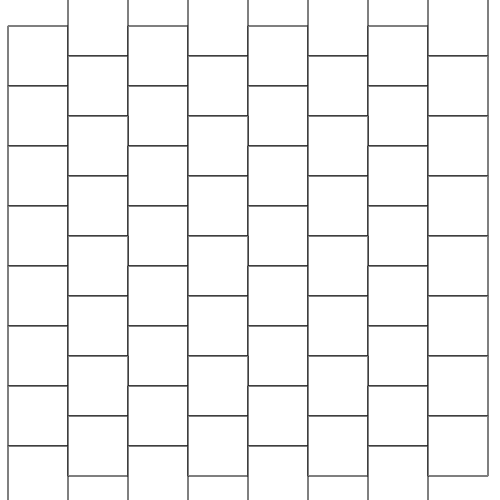
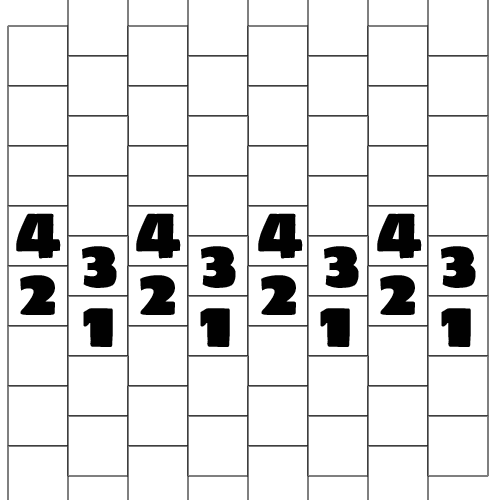
The construction of peyote fabric is that the beads are in a sawtooth pattern: the next row is half-way higher than the previous. That gives us a bit of a problem with the way to color this specific ‘map’. Yes, this does count as one.
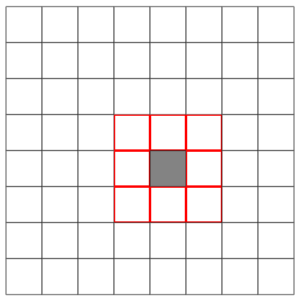
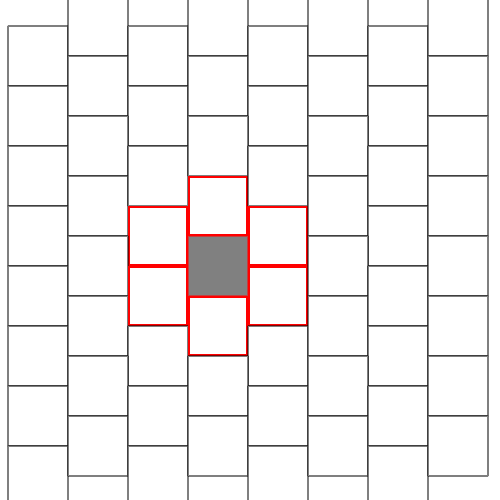
Unlike a regular grid of squares, where there are eight others surrounding one square, with a peyote fabric there are six. This staggering matters, because any one bead touches two on the sides and thus complicating matters just a tad.
Now, we got our map, let us color it. We have two ways that I’m aware of: by row and randomly.
By row is just that: working one color of beads per row.
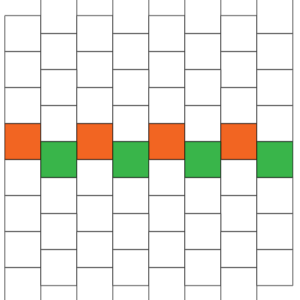
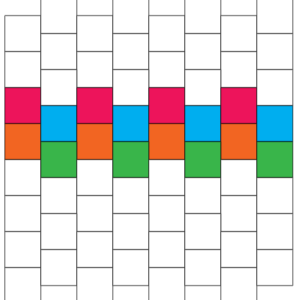
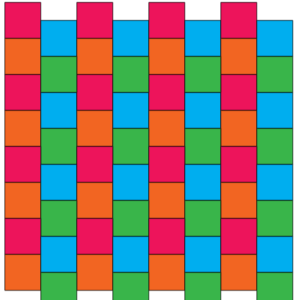
As you can see, the staggered effect can lead to vertical striping of a sort. If one wants to break apart the effect, we can always switch the color groups. In this case, placing the magenta/orange columns above the blue/green and vice-versa.
But what if, for whatever reason, we want a random layout?
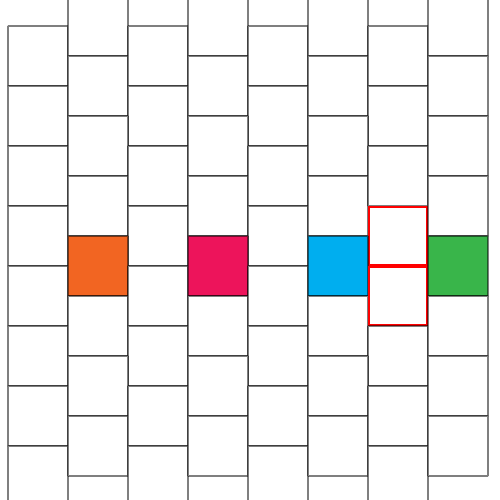
The area between the blue and green can’t be either, so we’re forced to choose one of the other two. Same goes for the other sets of squares between the other colors.
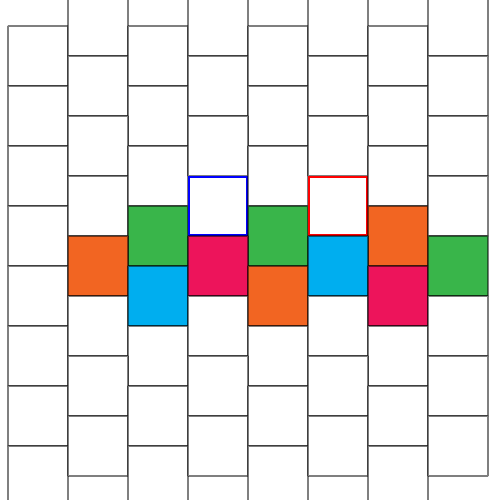
Seeing that the theorem permits one square touching two separate regions of the same color (in this case, the two green squares touching the magenta), the blue-lined square can be either blue or orange. The red-lined square is different, though. Three colors are used, thus forcing you to use the last one, which is magenta. Like so.
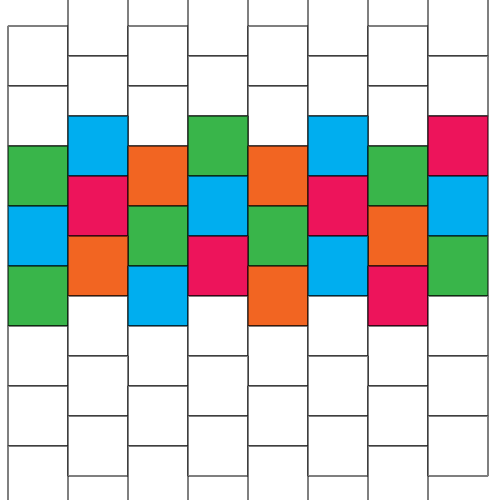
Now, this procedure depends on the first row, so if you want to be completely random, feel free to use a random number generator for it (or a four-sided die). It isn’t completely random, but it gives you some kind of randomness.
Seeing that the map is a square-based one, we can easily “fuse” two or more squares into groups that can be colored as mentioned. A few examples:
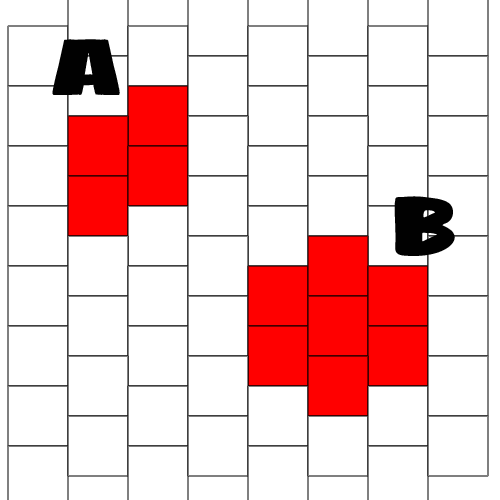
Each red shape is comprised of a group of beads in peyote stitch. Can either one of these two shapes, if mapped across the grid, be able to colored through the four-color algorithms I’ve explained above? I’ll leave this as an exercise for the reader.

Leave a Reply